

High-School Mathematics
Support for algebra, functions, calculus foundations, statistics, and mathematical reasoning.
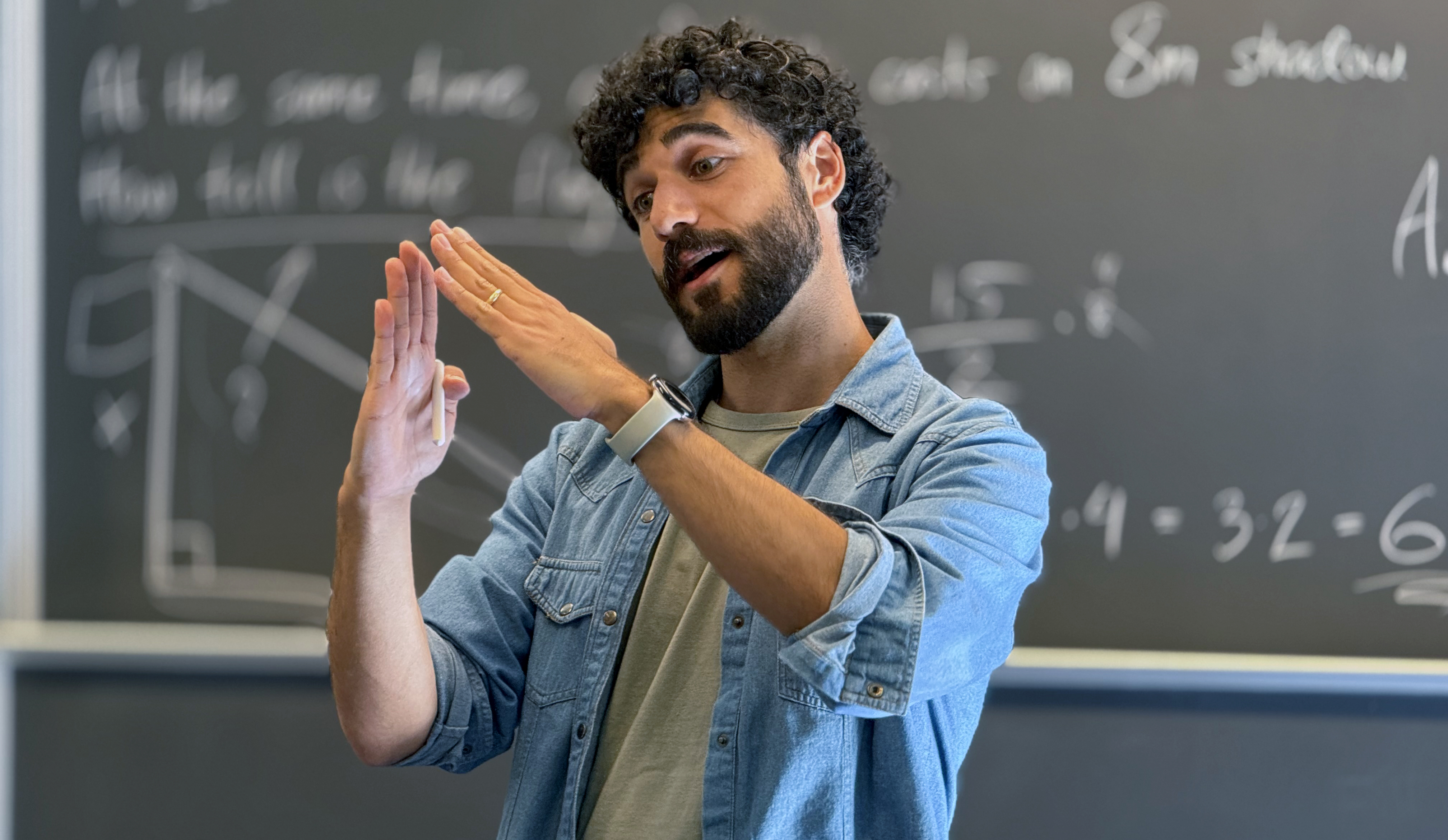
Upper-secondary mathematics is where the subject changes character. Up to a point students can get by on memorised procedures; then functions, calculus, and formal reasoning arrive more or less at once, and matching each question to a worked example from class stops being enough. This is the level I’ve taught for most of my career, and it’s the core of what I offer.
Who this is for
Students roughly age 15 to 19, working towards the exams that matter for university. In Zurich’s international schools that usually means one of a handful of curricula:
- IB Diploma — Analysis and Approaches (AA) or Applications and Interpretation (AI), at SL or HL
- IGCSE and A-Level — the British pathway
- American high school, including AP Calculus and AP Statistics
- Swiss Gymnasium mathematics, up to Matura level
The label on the course matters less than it looks. Underneath, these systems teach much the same mathematics in a different order and with different exam styles. What I do is fit the support to the course the student is sitting with respect to their syllabus.
One note for Swiss families in particular: students in a bilingual, English-immersion Matura track do their maths in English, even when they learned it in German up to that point. Helping a student make that switch is squarely what I do, and there’s a real case for starting before the track begins. A head start working through maths in English means the first immersion lessons feel familiar instead of intimidating, which takes much of the worry out of the decision to go bilingual at all. The mathematics itself doesn’t change; it’s the vocabulary, the way solutions are written up, and the exam that move into English, and that shift is far easier for a student who has already met it.
What we cover
At this level the ground runs across:
- algebra and functions (linear through to exponential, logarithmic, and rational)
- trigonometry and its identities
- differential and integral calculus
- sequences, series, and limits
- probability and statistics
- vectors and coordinate geometry
- and, at HL and the advanced tiers, complex numbers, proofs, and further calculus
We can start wherever a student needs to. That may be closing gaps left over from an earlier year or keeping pace with a demanding class.
How lessons work
We work from the student’s own course (e.g.,this week’s problem set or a test that went sideways) rather than a curriculum of my own. At this level a lot of marks are lost not necessarily to wrong answers but to reasoning an examiner can’t follow, so we spend a significant amount of time on setting work out clearly and on exam technique against the relevant marking scheme, including the unglamorous habit of checking whether an answer is even plausible before moving on.
Include the student’s year group, curriculum, current topic, and what feels difficult right now — so I can prepare properly for the consultation.
⚡ 0